
Forums
Back
Beta
AFM
What is the difference between leveraged beta & unleveraged beta? Whether asset beta & leveraged beta are same? Also how to identify in the question that the beta of debt be zero?

Answers (3)
1. Leveraged vs. Unleveraged Beta: - Leveraged Beta(or equity beta) measures the risk of a firm's equity compared to the market, taking into account the company's debt. It reflects the sensitivity of the company's stock returns to market returns. - Unleveraged Beta(or asset beta) measures the risk of a firm's assets, without the impact of debt. It reflects the company's business risk alone. 2. Asset Beta & Leveraged Beta: - Asset Beta is equivalent to unleveraged beta. It's the company's risk without the financial effect of leverage. - Leveraged Beta is typically higher than asset beta if the firm uses debt, as debt increases the firm's risk. 3. Beta of Debt: - The beta of debt is usually close to zero but not always zero. Debt is less risky than equity (because debt holders are paid before equity holders in the case of liquidation), and thus, the sensitivity of debt returns to market returns is lower. To identify if the beta of debt is zero, you'd look at the nature of the debt (e.g., fixed interest vs. variable) and the stability of the issuing company. If a firm operates without debt, its leveraged beta equals its unleveraged beta, because there is no financial risk from leverage to affect its volatility relative to the market.

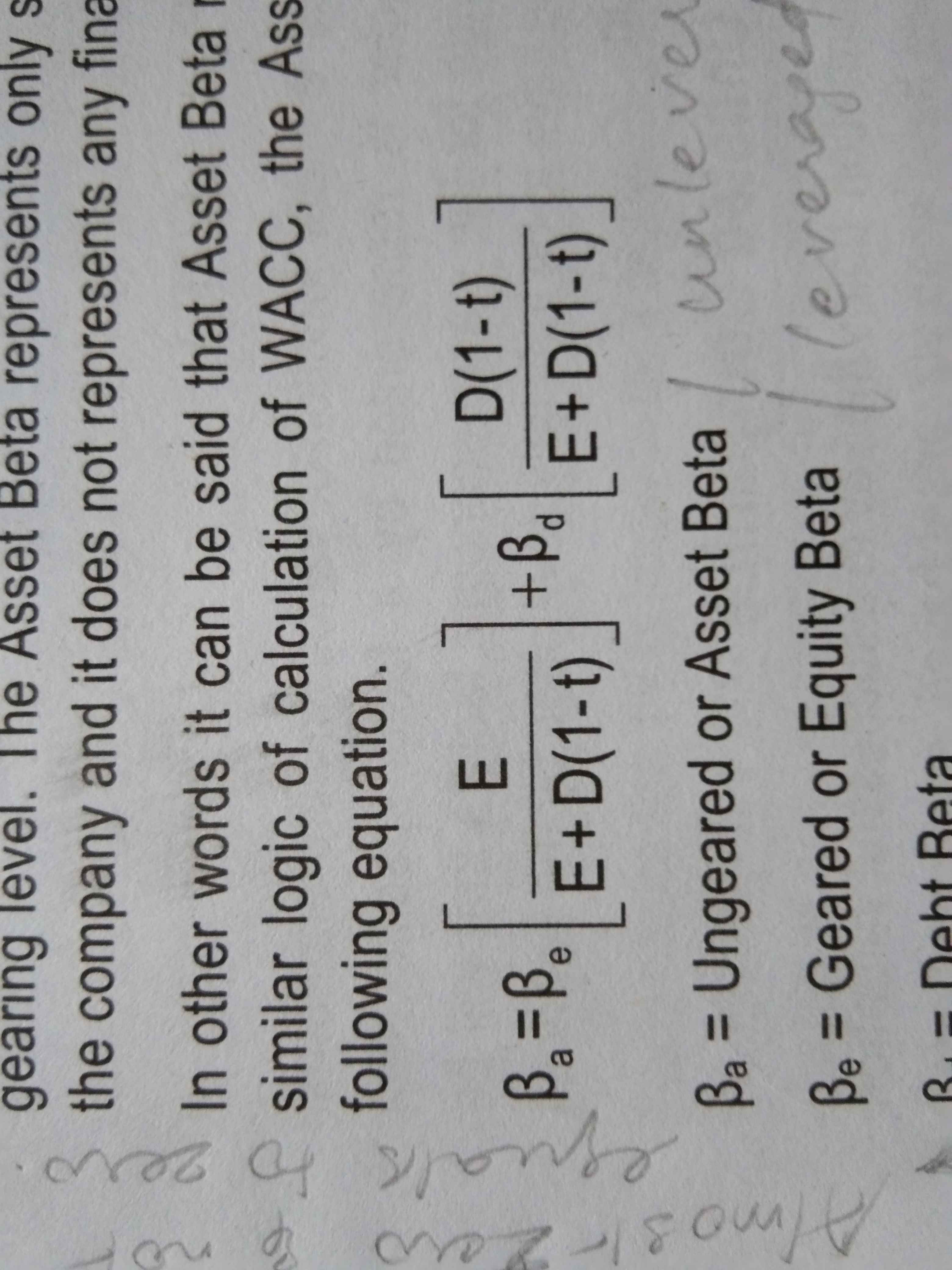
The inclusion of debt beta in the computation of the asset beta is to account for the financial risk that the debt adds to the firm's equity. The formula you've shown adjusts the equity beta for the effect of financial leverage (debt). Here's the reasoning: equity Beta : This is a measure of the risk of a company's equity relative to the market. It is "leveraged" because it reflects not just the business risk but also the financial risk due to the company’s debt. Debt Beta :This represents the risk of the company's debt also relative to the market. Generally, the debt of a company has some risk (though it's usually quite low compared to equity), especially if the interest rates are variable or the company's ability to meet its debt obligations is uncertain. Asset Beta : This is the unleveraged beta, reflecting the company's business risk without the effect of its capital structure. It is what the company's equity beta would be if it had no debt. When you adjust the equity beta for the impact of debt, you essentially strip out the financial risk to get the pure business risk (asset beta). Even though the debt beta is often low, especially for stable companies, it's not zero because debt holders require a risk premium above the risk-free rate, albeit much smaller than equity holders. Therefore, the formula provides a way to calculate the asset beta by considering both the equity beta and the proportion of debt adjusted for tax benefits, along with the debt beta to reflect the small amount of market risk associated with the company's debt. The tax shield (D(1-t)) is included because debt interest is tax-deductible, reducing the cost of debt and thus affecting the overall cost of capital.
Your Reply